

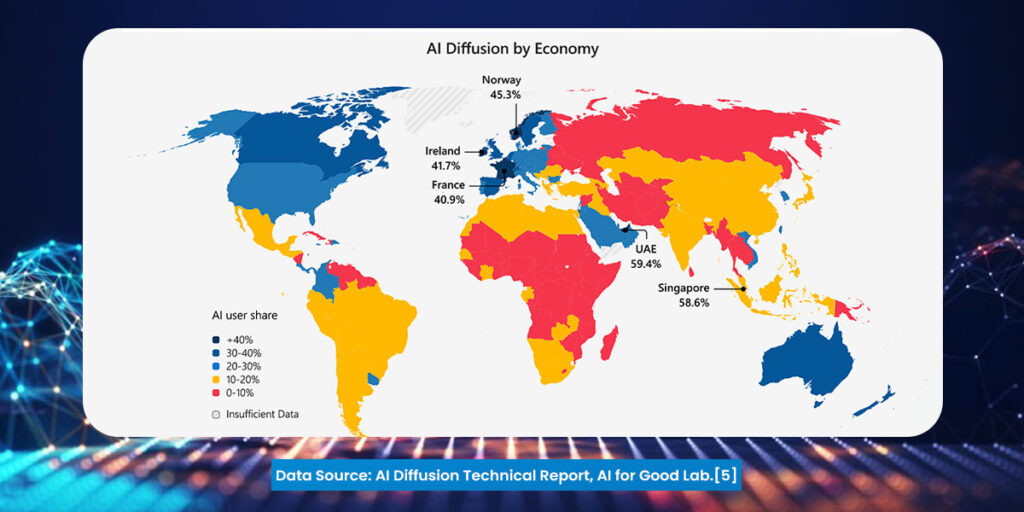
Artificial intelligence is shifting from a novelty to a necessity, and the United Arab Emirates is becoming the world’s most enthusiastic user. A new Microsoft AI Diffusion Report (Nov 2025) shows that 59.4% of the UAE’s working-age population actively uses AI in their work and personal lives.
Unlike traditional AI leaders, the UAE’s strength stems not from years of research or multinational companies. Instead, the country’s leadership comes from a strong national initiative, substantial investment, and rapid development of digital capabilities.
A New Approach to AI Leadership
The global AI race often highlights who builds the best models. However, the UAE shows that the real advantage lies in how widely AI is adopted, not just how well it is engineered.
Microsoft’s report puts the UAE above Singapore, Norway, and Ireland, countries known for their digital readiness but not necessarily for creating foundational AI systems. This indicates that the future of AI competitiveness will rely more on policy support, workforce preparation, and national technology deployment.
In short, the UAE demonstrates that a nation doesn’t need to excel in AI research to excel in AI usage.
How the UAE Achieved the Highest AI Uptake
The UAE’s rise didn’t happen by chance. It reflects a layered approach:
1. Long-term national planning
The UAE Strategy for AI 2031 centers AI in government transformation, integrating automation and data-driven decision-making into public services.
2. Large-scale digital modernization
AI-powered services are becoming standard in sectors such as healthcare, transportation, finance, and logistics.
3. Developing a domestic AI ecosystem
The UAE is nurturing its own model development, laying the foundation for local innovation.
4. Accelerated regional leadership
Recent initiatives, like the US$1 billion AI for Development program targeting Africa, show the UAE’s ambition to influence the AI landscape beyond its own borders.
The UAE’s Major Investment: A 5-gigawatt data center
One of the most significant projects underway is the construction of a massive data center campus in Abu Dhabi. Spanning 10 square miles, this site, developed by G42 with major US tech partners, is set to become one of the world’s leading hubs for AI infrastructure.
As access to computing power shapes which nations can develop and expand AI, this investment positions the UAE to become a regional computing powerhouse, not merely a front-runner in adoption.

Microsoft’s Growing Presence Shows Increased Global Confidence
Microsoft has committed $15.2 billion between 2023 and 2029 for:
– Expanding data centers in the UAE
– Advancing AI technologies
– Training 1 million UAE residents by 2027
Additionally, Microsoft has opened:
– A Global Engineering Development Center in Abu Dhabi
– A new AI for Good Lab to support nonprofits, startups, and research institutions throughout the Middle East and Africa.
Singapore Follows a Similar Path to Rapid Adoption
Singapore, ranked second globally in AI adoption with 58.6%, follows a similar path to the UAE. Though not a top producer of AI models, the city-state has:
– Over 1,100 AI startups
– Exceptional talent and digital readiness
– A strong national digitalization strategy
This success highlights a growing global trend: early investment and digital literacy can outweigh traditional measures of AI strength.
US and China Still Lead AI Model Development
While the UAE and Singapore excel in AI adoption, AI development and infrastructure are mainly found elsewhere.
US: Home of Leading AI Models
The United States, driven by OpenAI’s GPT-5 and other advanced systems, leads global AI innovation. Data from January 2025 shows:
– ChatGPT reached 700 million weekly active users
– It received 4.7 billion monthly visits, making it the most widely used AI tool
Other popular AI platforms include:
– Canva (887 million visits)
– Google Translate (595 million visits)
China: Rapidly Rising in Model Development
China’s DeepSeek is also growing rapidly, showing an astonishing 2,026% month-over-month increase.
Globally, leading AI models come from just seven countries: the US, China, South Korea, France, the UK, Canada, and Israel. This demonstrates a strong concentration of research excellence, funding, and semiconductor supply chains.

AI Infrastructure Remains Highly Concentrated
AI relies heavily on extensive computing and energy resources, and this dominance is clear:
The US and China account for 86% of global data center capacity.
Most AI training clusters and the largest GPU deployments are in North America and East Asia.
This imbalance emphasizes how important it is for emerging players like the UAE to invest heavily in data center infrastructure to support their AI ambitions.
AI Is the Fastest-Adopted Technology in History
The fastest-adopted technology ever, achieving over 1.2 billion users in less than 36 months,
Microsoft reports that AI surpassed:
– The Internet
– The personal computer
– The smartphone
Enterprises Are Rushing to Scale AI
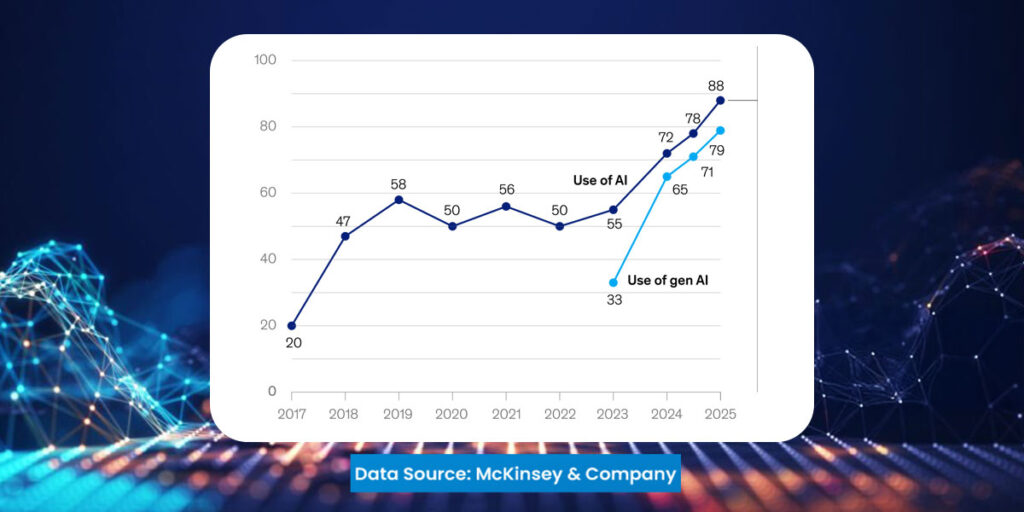
McKinsey’s 2025 global AI survey shows:
– 88% of organizations now use AI in at least one function, up from 78% in 2024.
– 62% are still in pilot phases, while approximately 33% are scaling AI across their operations.
Businesses are shifting from experimentation to widespread transformation, a trend expected to accelerate through 2026 and beyond.
Conclusion: The UAE Is Redefining What AI Leadership Means
The UAE’s leadership presents a new model for global competition in technology:
– Leadership can stem from ambition, not just early ecosystem development
– Rapid adoption can counter decades of technological lag
– Policy alignment is as crucial as research strength
– Investment in infrastructure can change global AI power dynamics
– Workforce readiness is now a national strength
The UAE is not just adopting AI faster than any other country; it is redefining what it means to lead in AI. Its approach offers a blueprint for other nations looking to advance in the digital age: Build infrastructure, coordinate policy, invest in talent, and adopt AI on a large scale.